 SENSRING
What makes SENSRING different?
Most phone notifications assume that the user can see, hear or respond to a screen. A smart ring can provide a different route to awareness. Instead of requiring continuous attention to the phone, SENSRING can send a subtle vibration to the finger when a supported sound is detected.
The ring is not a miniature hearing aid. It is an accessibility wearable and a vibration alert ring: the phone performs supported sound recognition, evaluates the scene selected by the user, and sends a Bluetooth alert to the ring. This makes the result easier to understand for people comparing terms such as smart ring for deaf people, vibrating ring for deaf people and wearable for hard of hearing people.
SENSRING does not claim to recognise every sound. Performance varies with the phone, distance, background noise, battery, permissions and settings. Test your own environment before relying on any assistive alert.
How the smart ring works
- Choose a scene: Select the sound context you want to monitor, such as a doorbell or baby-cry scene.
- The phone listens: Supported recognition runs locally for core sound scenes.
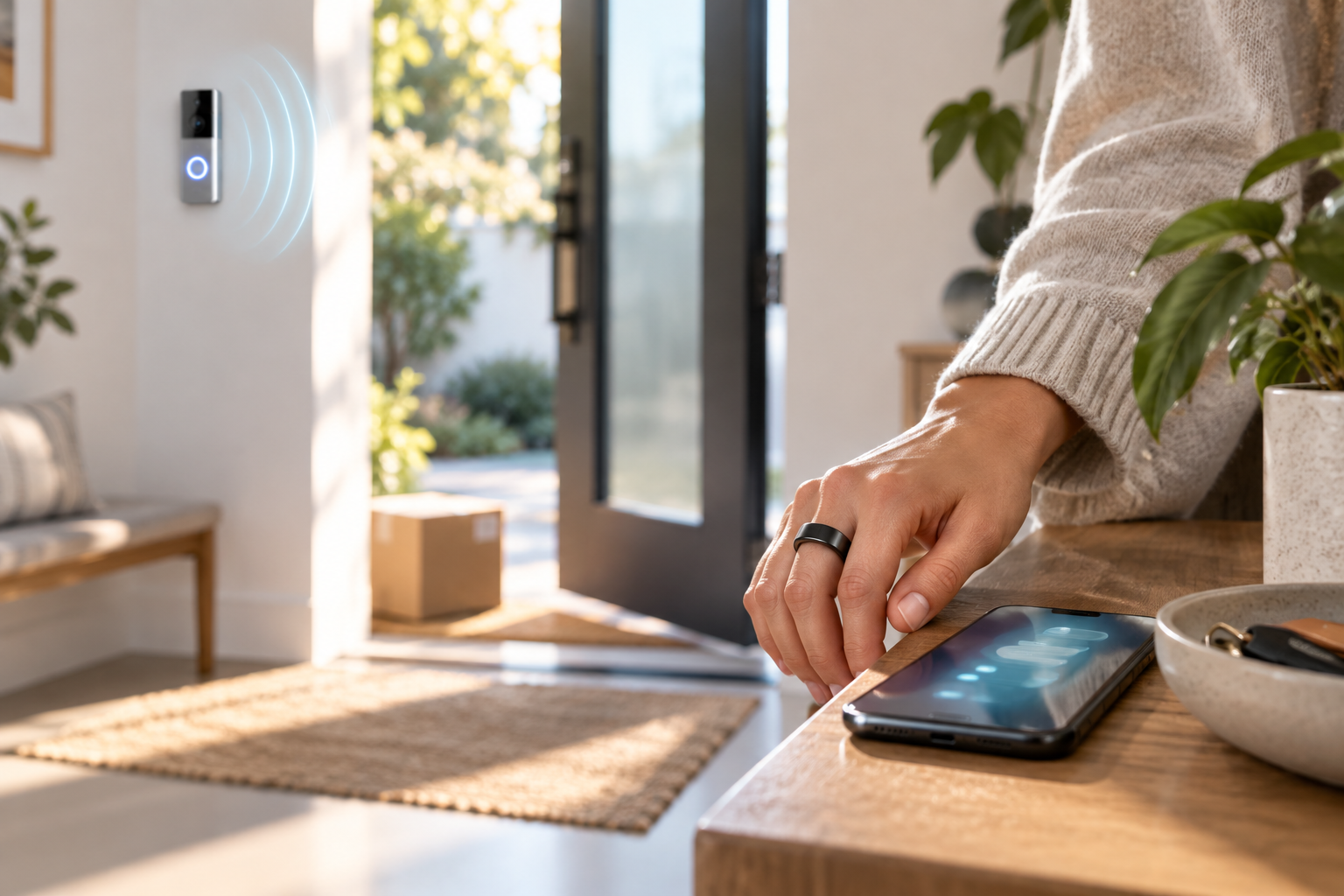
- The ring receives the alert: When the sound matches the selected scene, Bluetooth can deliver an alert to the ring.
- You feel the cue: The ring vibrates against the finger, adding another way to notice the event.
Supported everyday sound scenes
| Scene | User need | Important limit |
|---|---|---|
| Doorbell | Notice a supported visitor or delivery alert without watching the phone. | Doorbell sound, distance, walls and background noise affect recognition. |
| Smoke or fire alarm | Receive an additional tactile alert when a supported alarm sound is detected. | Keep certified alarms, visual devices and an established escape plan. |
| Baby cry | Add another way to notice supported crying from another room. | Keep a dependable childcare process and test the real home environment. |
| Car horn | Add a cue when a supported horn is detected during walking, cycling or commuting. | Use direct observation and normal road safety; do not rely on the ring alone. |
Deaf and hard of hearing: one product, different needs
The words Deaf and hard of hearing describe different experiences and identities. They should not be treated as interchangeable medical labels. Some people use sign language and may not use speech to communicate; others use hearing aids, cochlear implants, captions or a combination of tools.
The common product question is practical: would another notification channel be useful in daily life? A smart ring may suit someone who already keeps a phone nearby, wants a discreet cue and is willing to test comfort, vibration strength and recognition in their own rooms.
More than sound alerts
The SENSRING companion app also supports everyday accessibility features. These are separate from the four environmental sound scenes and may depend on platform support, permissions and network conditions.
- Live captions: Turn supported speech into on-screen text during everyday communication.
- Name recognition: Help draw attention to a selected name when supported by the app.
- Messages and reminders: Carry other digital cues close at hand.
- Vibrating alarms and reminders: Add tactile notification for selected personal events.
- Core access: Core SENSRING functions are designed without a recurring subscription requirement.
Read the live captions guide to understand speech-to-text limitations and privacy considerations.
Who may benefit from an accessibility smart ring?
Smart ring vs. smartwatch or wristband
| Wearable | Potential advantage | What to consider |
|---|---|---|
| Smart ring | Small, discreet and worn on the finger | Ring size, comfort, vibration clarity, battery and phone connection |
| Smartwatch | Larger display and access to apps | Size, charging, screen attention and app compatibility |
| Vibrating wristband | Larger surface and sometimes longer battery | Comfort, charger type and how alerts are configured |
| Flashing receiver | Strong visual signal for a fixed room | May not be noticed outside its line of sight |
Compatibility and responsible use
SENSRING currently supports Android 8.0 or later and iOS 13 or later with Bluetooth 5.0. The ring needs an operating phone nearby, a charged battery and the permissions required by the app. Recognition is limited to supported scenes and can be affected by AC units, televisions, traffic, room layout and other sounds.
Keep existing safety and communication systems. A vibration alert should be treated as an additional cue, not as a certified emergency alarm, medical device or guaranteed substitute for a hearing aid.
Continue with the companion app
Check compatibility, install the app and follow the pairing instructions.
Smart ring questions
What is a smart ring for deaf people?
It is a wearable assistive device that can provide discreet vibration alerts after a connected phone recognises supported sounds. It does not restore hearing.
Does SENSRING work as a hearing aid?
No. It does not amplify sound and is not a hearing aid, cochlear implant or medical device. It adds an assistive awareness channel for selected sounds.
Does the phone need to be nearby?
Yes. Supported sound recognition runs on the phone and Bluetooth sends alerts to the ring. Distance, battery, permissions and disconnection affect the experience.
Is a smart ring suitable for every deaf person?
No single assistive device fits everyone. Communication preferences, comfort, phone compatibility, alert needs and the environments you use matter. Test before relying on it.
Independent background reading
These general hearing-loss resources do not review or endorse SENSRING.